Featured and Trending
What Is a Virtual Medical Receptionist? A Complete Guide for Practice Owners

A virtual medical receptionist is a HIPAA-trained professional who handles a practice’s phones, scheduling, and patient intake from outside the physical office, working inside the practice’s own EHR and phone system. The work is the same as an in-house front desk role: answering calls, booking and confirming appointments, verifying insurance, and routing messages to the right person. The location is the only thing that changes.
For most practice owners, the real question isn’t “what is it.” It’s “can I trust this with my patients and my compliance exposure.” Edge’s January 2026 Workforce Bottleneck Survey of 254 healthcare leaders found that 76% report high or extremely high administrative workload, and 74% of patient inquiries take more than a day to resolve because of it.
Scheduling and intake ranked among the four most strained areas in the practice. The phones don’t stop ringing because demand dropped. They don’t stop ringing because the practice is short on the capacity to answer them.

What does a virtual medical receptionist actually handle day to day?
A virtual medical receptionist covers the full front-desk workflow: inbound and outbound calls, appointment scheduling and confirmations, new patient registration, insurance eligibility checks, and message routing between patients, providers, and staff.
In a typical week, that looks like answering and triaging inbound calls including after-hours overflow, scheduling and confirming appointments across provider calendars, collecting new patient demographic and insurance information, running basic eligibility checks before the visit, sending reminders and following up on no-shows, managing recall lists for preventive care, and documenting every call inside the EHR.
Dr. Daljeet Saluja, Medical Director at Saluja Medical Associates in Baltimore, put it this way after building out his own team: “It’s a mistake to use Edge staff just for answering phones. Let them grow with you and you’ll be surprised how much they can do.” His practice started with call coverage and expanded into insurance verification and clinical follow-up over eighteen months.
Virtual medical receptionist vs. medical scribe vs. “virtual assistant”: what’s actually different
These terms get used almost interchangeably online, which is most of the confusion. They cover different work.
| Virtual Medical Receptionist | Medical Scribe | “Virtual Assistant” (Generic Industry Term) | |
|---|---|---|---|
| Core Focus | Front desk and scheduling capacity | Clinical documentation capacity | No fixed scope; varies by vendor |
| Typical Tasks | Calls, booking, intake, insurance verification | Real-time charting, dictation, order entry, chart prep | Anything from email to data entry; undefined by the label itself |
| Training Standard | Medical terminology, HIPAA, payer basics, practice’s own EHR | Clinical terminology, EHR documentation standards, coding references | No industry standard; varies by provider |
| Documented Example | Saluja Medical Associates: call answer rate rose from 75–80% to above 90% | Balboa Nephrology Medical Group: 40 hours a month returned to physicians previously spent scribing | Not applicable; the term describes no specific role |
>
The label “virtual assistant” is the one to be careful with. It’s a catch-all that tells you nothing about training or scope. A receptionist and a scribe solve two different bottlenecks, at the front desk and in the exam room, and each needs training built for that specific work.
Signs your practice could benefit from one
The pattern before practices make this change is consistent: the phones are consuming time the practice doesn’t have, and the cost shows up in missed revenue and physician burnout, not just missed calls.
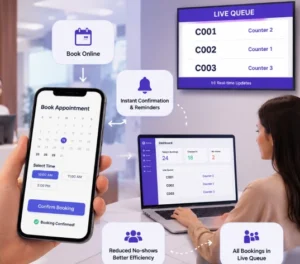
Common signs include calls going to voicemail during business hours, same-day appointments falling through because no one had time to confirm them, insurance verification happening reactively at check-in instead of before the visit, physicians or office managers doing phone and scheduling work instead of clinical work, and local front-desk hires that turn over every few months, restarting the training cycle each time.
None of these are demand problems. Patients are calling. The practice doesn’t have the capacity to answer.
Is it secure enough for patient data, and what should you look for in a provider?
Security depends entirely on how the arrangement is structured, not on where the person sits. A properly built setup uses HIPAA-compliant device provisioning, controlled EHR access, and ongoing compliance monitoring, the same standard a practice would expect from any staff member with system access.
Dr. Naureen Alim, a rheumatologist at CLS Health in Houston, had tried a virtual staffing model before Edge and found the compliance and oversight fell entirely on her. With Edge’s managed infrastructure, including device provisioning, EMR configuration, and always-on IT and compliance monitoring, that changed: “The biggest difference that Edge has made is peace of mind. I stopped searching locally for talent and trying to hire and train somebody.” Her Edge team member has stayed in place for more than two years.
Before signing with any provider, confirm four things: documented HIPAA training before the first patient call, controlled access to your specific EHR, a defined escalation path for anything outside the role’s scope, and a backup plan if the person is out.
What does the impact actually look like?
DHR Health, a physician-owned health system serving 1.4 million patients across 133 locations, shows how far this scales: a pilot of 3 to 5 dedicated administrative professionals grew to 23 within 12 months, with a 71% increase in productivity and hiring time cut by 53%. Marcel Twahirwa, MD, of DHR Health’s Diabetes & Endocrinology Institute: “Edge has been the difference that our clinic needed”.
At the smaller end, Saluja Medical Associates was answering only 75-80% of its 450 daily inbound calls before building out its team; that rate now sits above 90%. Insurance verification moved from reactive, at check-in, to 96-97% resolved before the patient arrives.
Cost is part of this conversation, but it’s worth being precise about where it fits. Dr. Jyothi Mamidi Juarez, an endocrinologist in Houston, saw a 40% reduction in administrative cost, but describes the actual change differently: “I’ve been able to go home earlier… I take vacations when I want because I know my Edge employees will take care of everything in the background.” The savings followed once the capacity problem was solved, not the other way around.
How do you get one running in your practice?
Getting a virtual medical receptionist in place usually follows a phased path rather than a single hire-and-go moment.
- Confirm the scope. Start with the highest-friction task, usually phones and scheduling, before adding billing or verification.
- Match and onboard. A trained team member is matched to the role and set up inside your systems, with a defined ramp period.
- Run a trial window. Most practices see the pattern within the first one to three months.
- Expand deliberately. As Dr. Saluja’s practice shows, scope tends to grow into verification and clinical support once trust is established, not before.
Dr. Saluja didn’t set out to redesign his operations. He set out to stop losing patients to unanswered phones. The redesign followed.
FAQ
Is a virtual medical receptionist HIPAA-compliant?
It can be, but compliance is a function of setup, not job title. Look for HIPAA-compliant device provisioning, controlled EHR access, and ongoing monitoring rather than assuming compliance comes standard with any virtual hire.
How is a virtual medical receptionist different from a “virtual medical assistant”?
A virtual medical receptionist covers front-desk and scheduling work, with training specific to that job. “Virtual medical assistant” is a generic industry label with no fixed scope, so the same title can mean very different things depending on the provider using it.
How fast can a virtual medical receptionist start handling calls?
Documented onboarding timelines range from about two weeks to a few weeks, depending on system complexity, compared to a 30-49 day local hiring average in several case studies. If your front desk is the bottleneck, a fifteen-minute conversation is enough to know whether this fits your practice. Book a call, or see the specific medical roles Edge staffs today.
If your front desk is the bottleneck, a fifteen-minute conversation is enough to know whether this fits your practice. Book a demo, or see the specific medical roles Edge staffs today.
Ready to see what a structured accounting team looks like for your business? Book a demo, or see the Bookkeeper, Accountant, and Analyst roles Edge staffs today.
More from Medical

Healthcare Administrative Capacity Crisis: Why Care Delivery Is Slowing
For years, operational strain in healthcare has been framed as a staffing shortage. But the data points to something deeper: a healthcare administrative capacity crisis. Organizations are being asked to reduce staffing while administrative workload continues to rise, creating a widening gap between the work that must get done and the capacity available to execute …

The Future of Healthcare Staffing Isn’t Remote. It’s Responsible.
Healthcare leaders don’t need another trend to chase. They need staffing models that actually hold up under pressure. Across the industry, the challenges look remarkably similar. Patient volumes continue to rise. Documentation requirements expand every year. Prior authorizations slow care delivery. Bilingual communication is inconsistent. And non-clinical turnover remains stubbornly high. Most organizations respond the …

Why Physician-Led Healthcare Systems Are Rethinking Staffing Models
Burnout didn’t suddenly appear in healthcare. What changed is how much administrative weight clinicians are expected to carry alongside patient care. For physician-led healthcare systems, this pressure shows up first and hardest. These leaders aren’t just practicing medicine. They’re running operations, managing staff, and absorbing the downstream effects of every hiring delay, every turnover, every …